ESD Simulators for Every EMC Test Lab
Contact or air. Both polarities. Every test point.
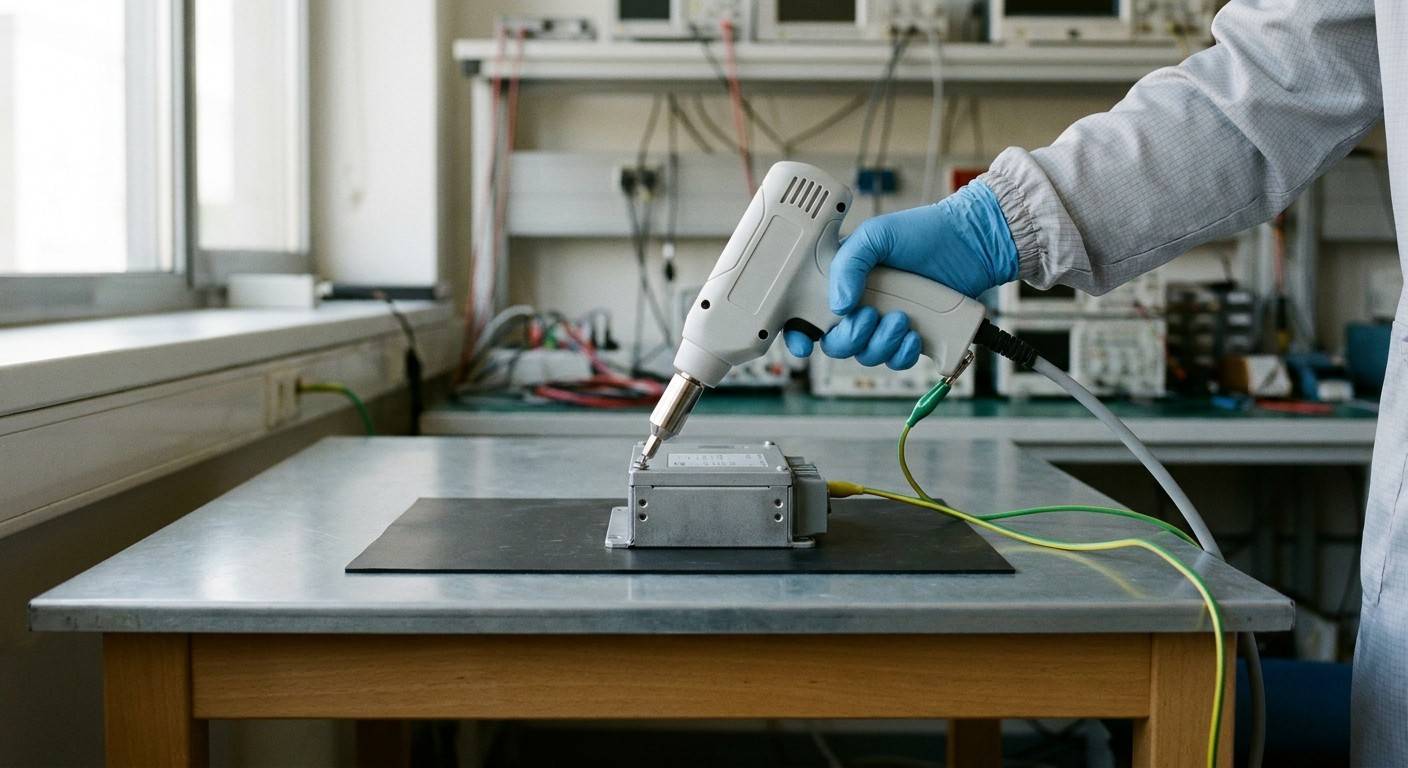
An ESD simulator puts the same static shock into a product every time you pull the trigger, at the voltage you set, so you can find out on the bench whether it resets, locks up or loses data. This guide covers how the guns work, the standards they test to, the bench they sit on and what to ask for in a quote.
How an ESD simulator works
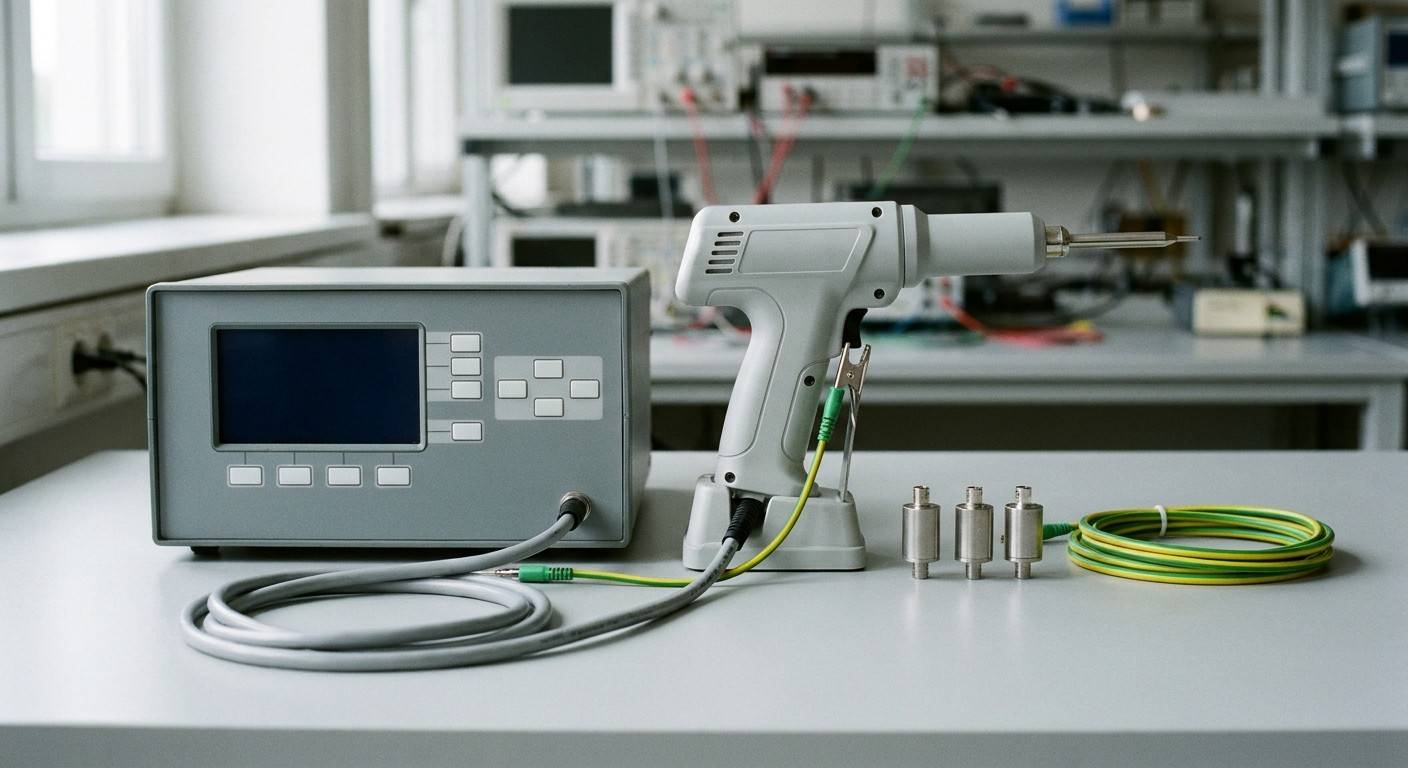
An ESD simulator, also sold as an ESD gun or ESD generator, copies the spark you get when a charged person touches something. Inside, a high-voltage supply charges a small capacitor through a large resistor. When you pull the trigger, that charge goes out through a second resistor and the tip, into the product.
IEC 61000-4-2 fixes the two values that shape the pulse: 150 pF for the capacitor and 330 ohms for the resistor it discharges through. Get those right and connect the ground return, and two labs testing the same product at the same voltage should put the same current into it.
- Charging resistor
- It sits between the high-voltage supply and the capacitor, typically 50 to 100 megohms, so the capacitor charges slowly and the supply stays out of the discharge.
- Storage capacitor
- 150 pF in IEC 61000-4-2. It holds the charge a person would carry.
- Discharge resistor
- 330 ohms. It models someone discharging through a metal object in their hand, like a key or a screwdriver.
- Relay and tip
- For a contact discharge, a relay in the gun lets the charge go once the tip is already touching. For an air discharge, the spark across the gap does the switching.
- Ground return cable
- It runs from the gun back to the ground of the test setup. The discharge current returns through it, so it has to be connected for every shot.
Contact discharge and air discharge
IEC 61000-4-2 prefers contact discharge and falls back on air discharge where contact can't be applied. Which one you use depends on the surface in front of the tip.
| Aspect | Contact discharge | Air discharge |
|---|---|---|
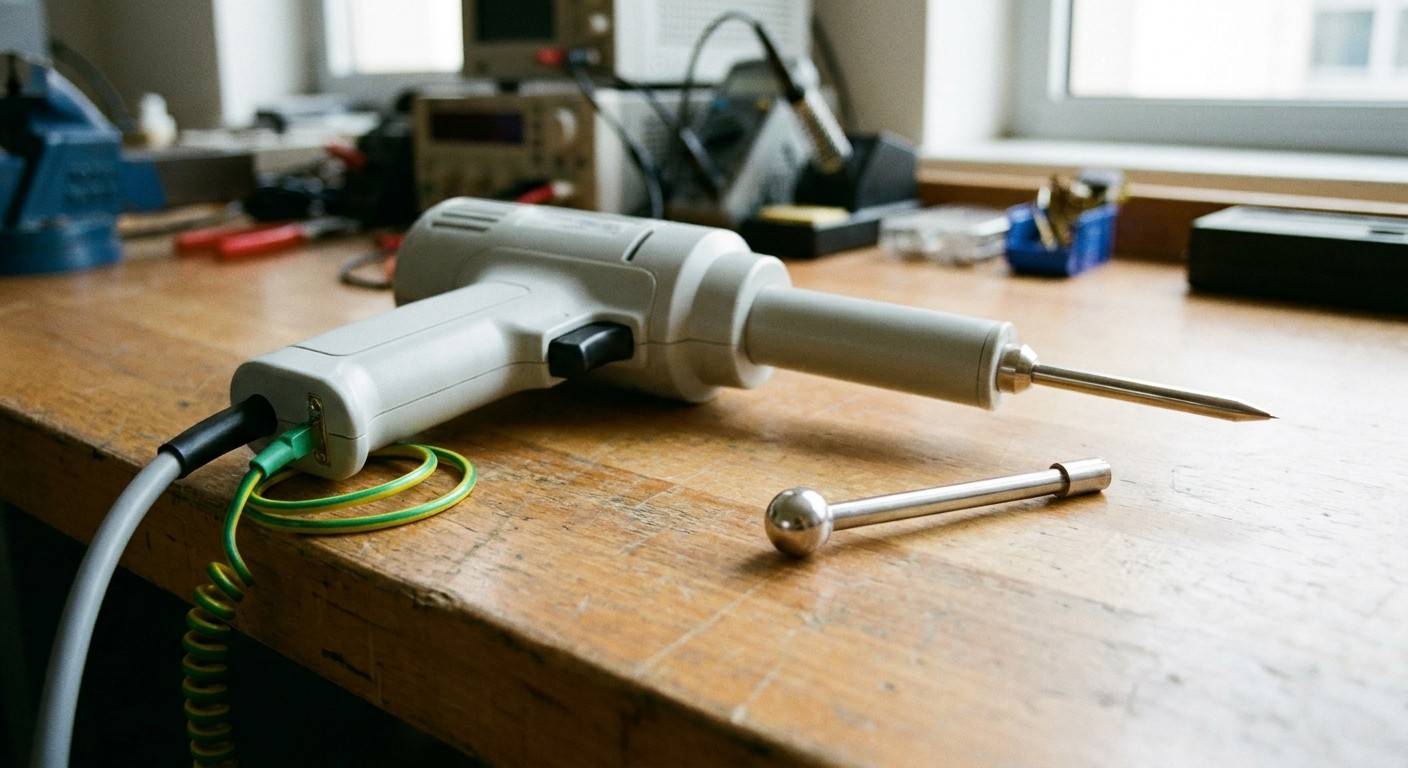
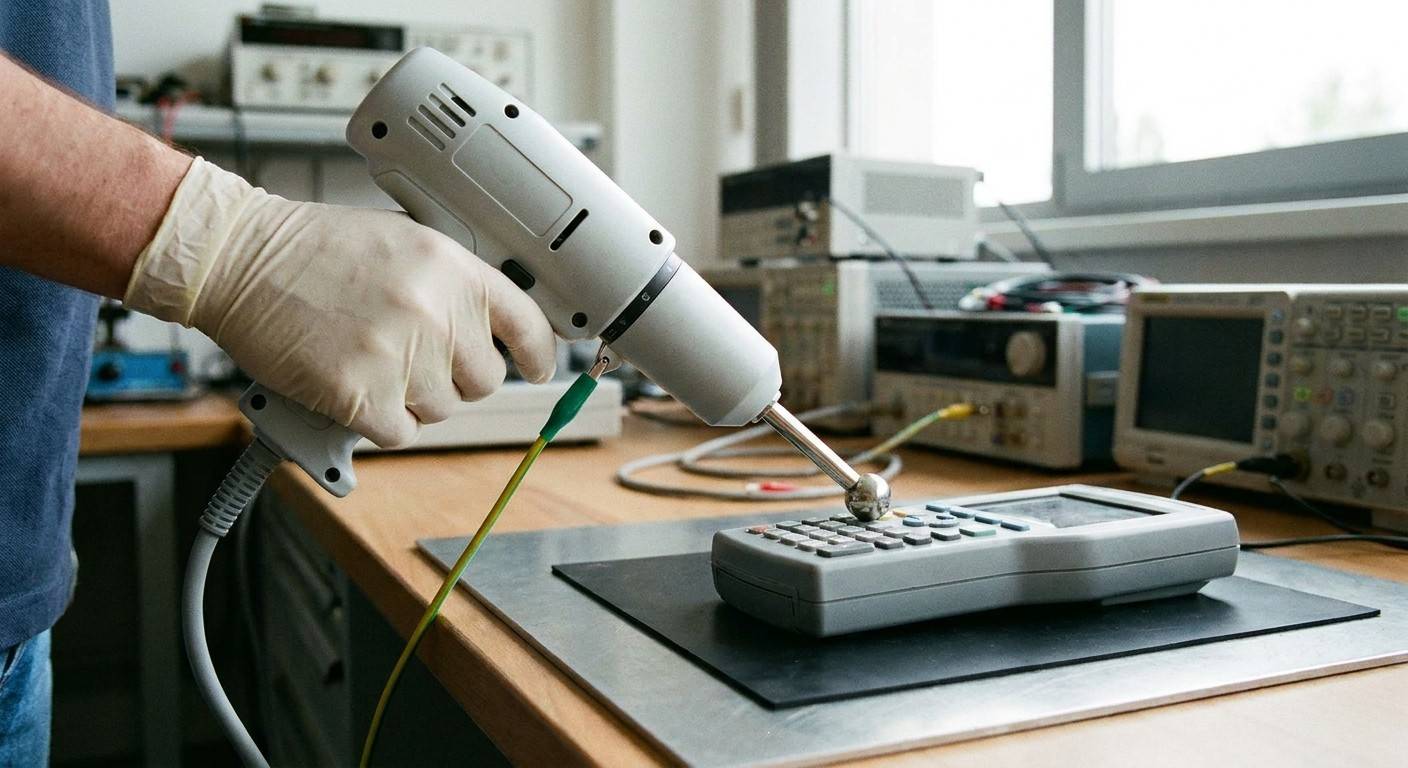
| Tip | ContactPointed. It goes on the product before you pull the trigger. | AirRounded. You charge it and bring it in until the spark jumps. |
| Where it goes | ContactMetal a person can touch: housings, connector shells, screw heads. Also the coupling planes, for indirect discharges. | AirPaint, plastic, seams, slots, keypads and anything else that won't take a contact discharge. |
| What releases it | ContactA relay inside the gun. | AirThe spark itself. |
| IEC 61000-4-2 levels | Contact2, 4, 6 and 8 kV | Air2, 4, 8 and 15 kV |
| Technique | ContactHold the tip on the point and keep it there until the discharge has happened. | AirCome in as fast as you can without hitting the product, and keep the room inside its humidity range. |
Which standard sets the test
The gun is much the same in every lab. Your product standard or your customer's specification decides the network, the voltages and how many shots go where.
| Standard | Covers | Network | What it asks for |
|---|---|---|---|
| IEC 61000-4-2 (EN 61000-4-2) | The basic ESD immunity test that most product EMC standards refer to. | 150 pF, 330 Ω | Contact 2 to 8 kV and air 2 to 15 kV over four levels, plus an open level X. The third edition came out in March 2025. |
| ISO 10605 | Electronic modules for road vehicles. | 150 or 330 pF; 330 or 2,000 Ω | Tests modules both powered and unpowered. Which capacitor and resistor you use depends on where and how a person would touch the part. |
| IEC 60601-1-2, 4th edition | Medical electrical equipment. | IEC 61000-4-2 method | 8 kV contact and 15 kV air for professional and home healthcare settings, up from 6 kV and 8 kV in the previous edition. |
| RTCA DO-160, Section 25 | Equipment carried on aircraft. | As the section specifies | 15 kV, with ten discharges of each polarity at every test point. |
| ANSI/ESDA/JEDEC JS-001 (HBM) | Single components such as ICs. Listed here so it isn't confused with the others. | 100 pF, 1,500 Ω | Runs on a dedicated component tester, not an ESD gun. |
Vehicle work needs more than one network
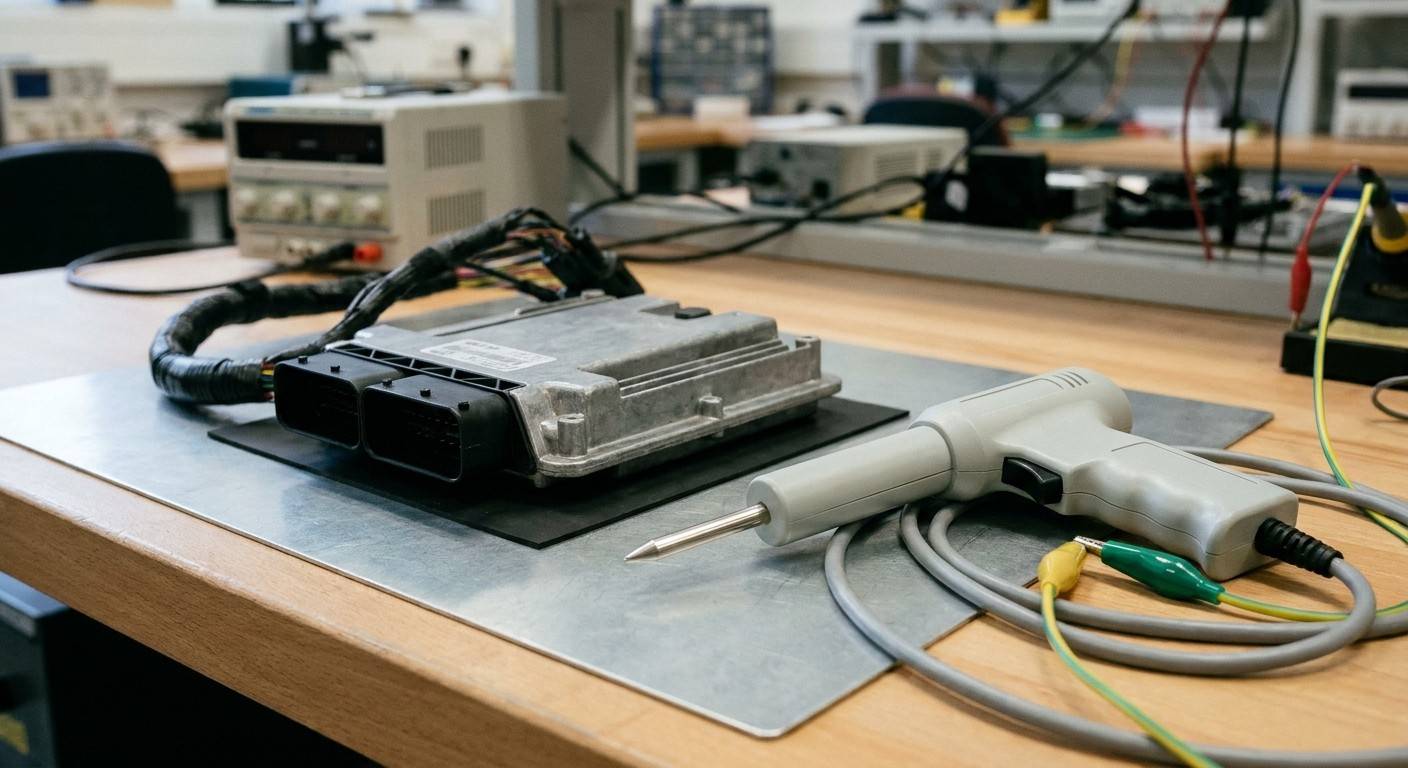
ISO 10605 models more than one kind of touch. It uses 150 pF for a person standing outside the vehicle and 330 pF for someone sitting in it, and 330 ohms for a discharge through a metal object against 2,000 ohms for one straight from the skin. Of those combinations, 330 pF with 330 ohms delivers the most energy.
If you test to vehicle makers' specifications, check which networks the gun takes and how quickly you can swap them.
A chip's HBM rating is a different test
The human body model figure on a component datasheet comes from ANSI/ESDA/JEDEC JS-001: a 100 pF, 1,500 ohm network on a dedicated component tester. It rates the part on its own. An ESD gun tests the finished product, and fitting it with an HBM-style network does not make it an HBM tester.
Checking the pulse
Two guns set to 4 kV are only interchangeable if they put the same current into the product. So IEC 61000-4-2 defines the current itself, at four checkpoints, and every gun is verified against them.
- Rise time
- 0.8 ns ±25%
- From 10% to 90% of the first peak.
- First peak
- 3.75 A per kV ±15%
- 15 A at 4 kV.
- Current at 30 ns
- 2 A per kV ±30%
- Timed from the 10% point.
- Current at 60 ns
- 1 A per kV ±30%
- Timed from the 10% point.
IEC 61000-4-2 test levels
| Level | Contact | First peak | 30 ns | 60 ns | Air |
|---|---|---|---|---|---|
| 1 | 2 kV | 7.5 A | 4 A | 2 A | 2 kV |
| 2 | 4 kV | 15 A | 8 A | 4 A | 4 kV |
| 3 | 6 kV | 22.5 A | 12 A | 6 A | 8 kV |
| 4 | 8 kV | 30 A | 16 A | 8 A | 15 kV |
| X | Open. The product standard sets the value. | ||||
Currents are for contact discharge. A product tested at one level has to pass every level below it as well.
How a gun is verified
The gun fires into a current target set into the middle of a large metal plane. The target feeds an oscilloscope through an attenuator, with the cabling kept under a meter, and you read the four checkpoints off the screen.
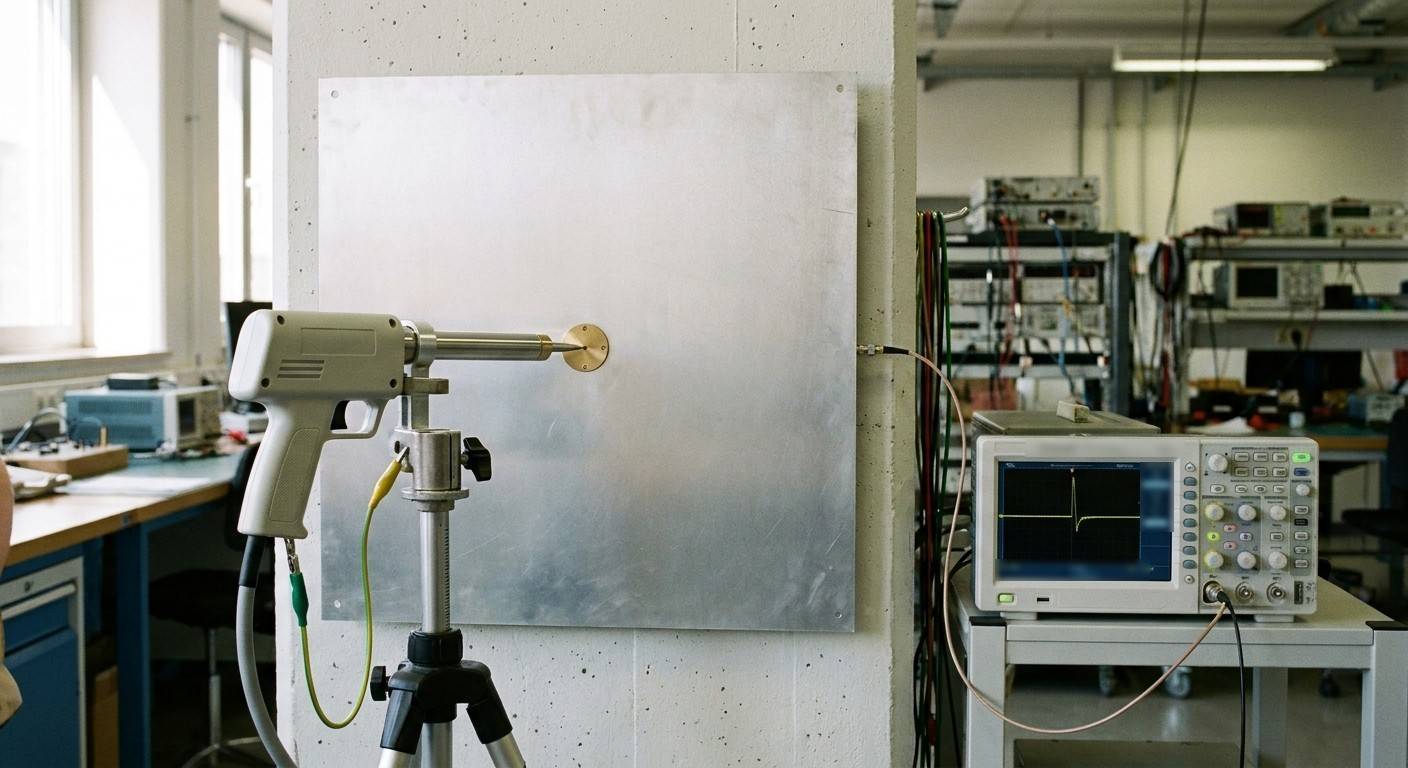
The third edition of IEC 61000-4-2, published in March 2025, reworks the current calibration and adds a calibration requirement for the air discharge tip. If your accreditation or your customer cites the 2025 edition, make sure your calibration certificate does too.
The bench around the gun
An ESD result is only useful if another lab can rebuild the setup and get the same answer. IEC 61000-4-2 spells the bench out.
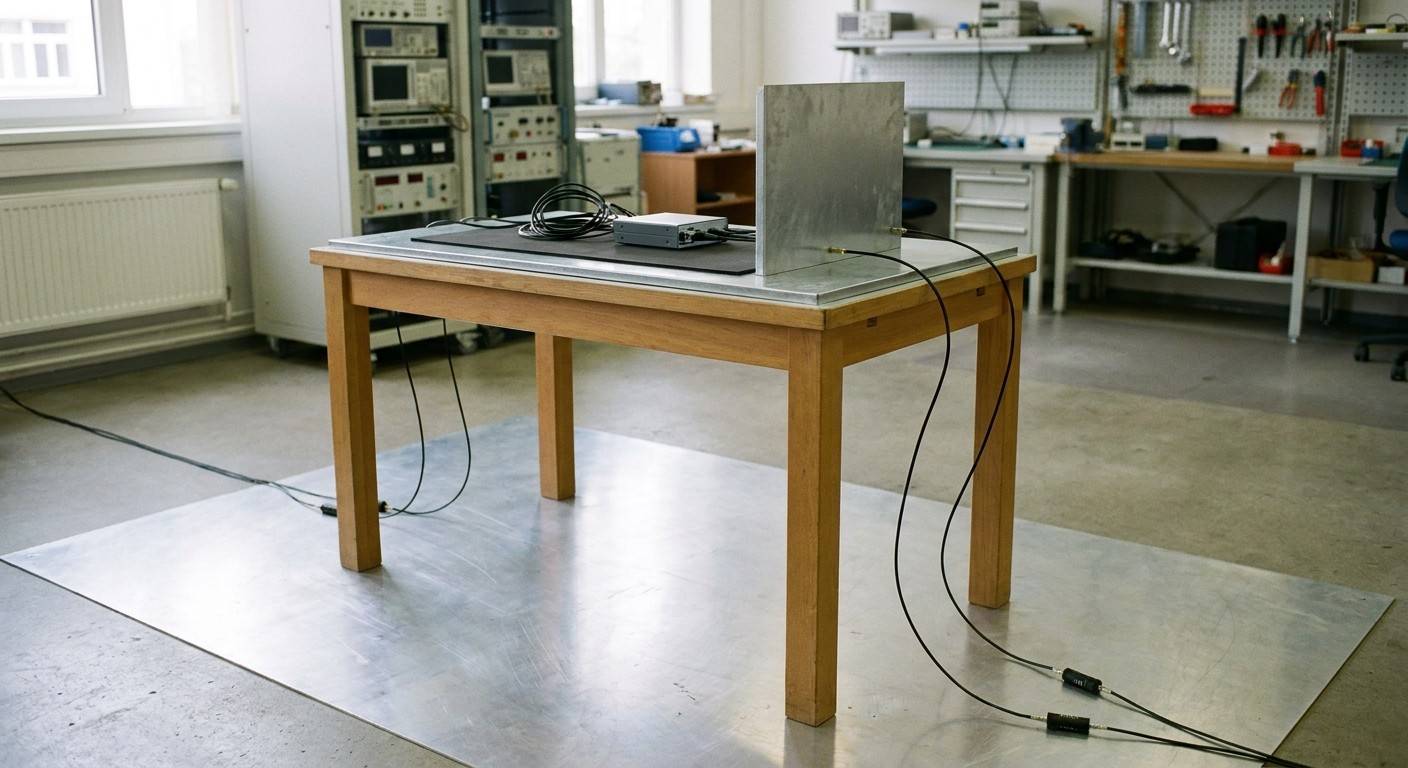
- Ground reference plane
- A metal sheet on the floor under the whole setup. The bleed cables from both coupling planes end on it.
- Wooden table
- 0.8 m high, for table-top equipment. Floor-standing equipment sits on an insulating pallet at least 0.1 m high instead.
- Horizontal coupling plane
- A 1.6 m by 0.8 m metal sheet covering the tabletop.
- Insulating mat
- 0.5 mm thick. It keeps the product and its cables off the coupling plane.
- Equipment under test
- The product being tested, with its cables, sitting on the insulating mat.
- Vertical coupling plane
- A 0.5 m square plate standing 0.1 m from the product, for indirect discharges beside it.
- Bleed cables
- Each plane connects to the floor plane through a cable with two 470 kilohm resistors, so charge drains away between shots.
Indirect discharges
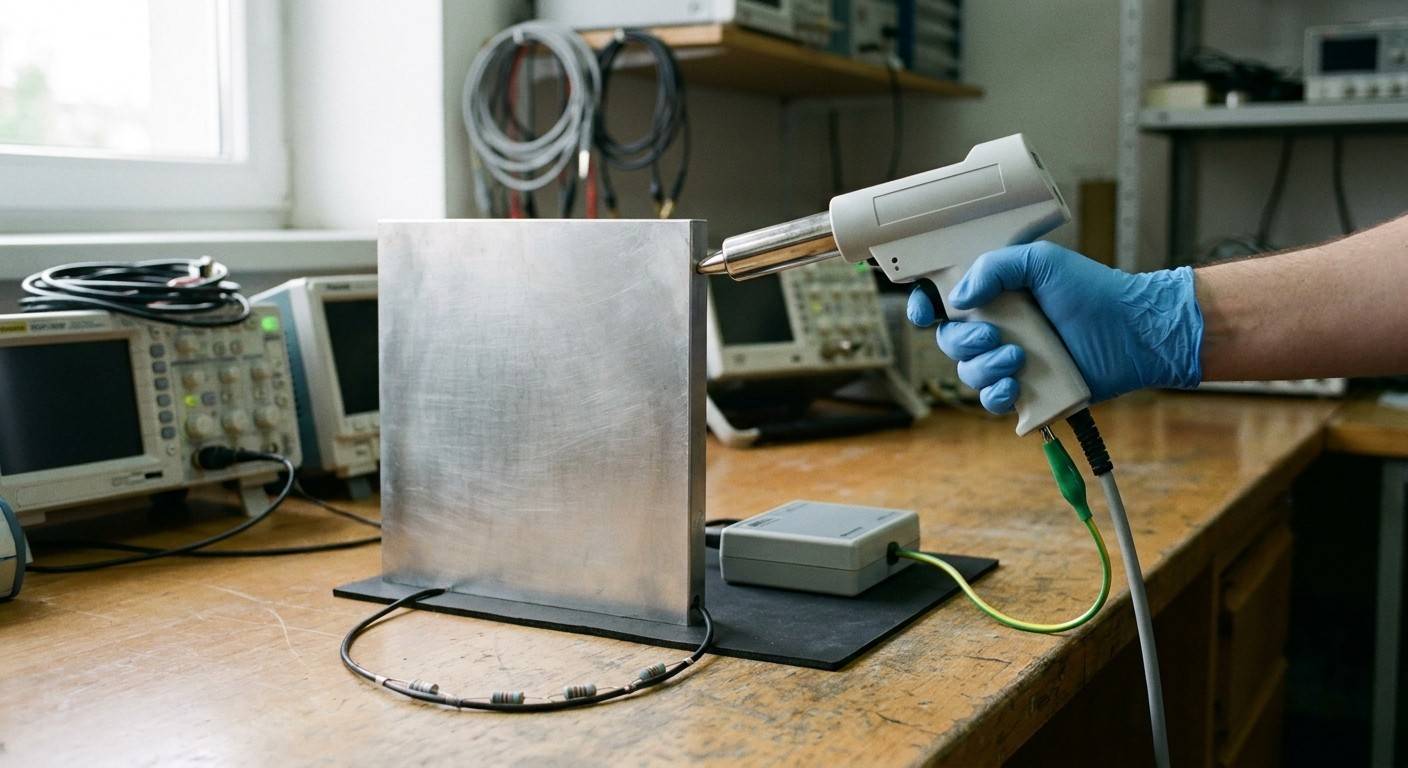
Not every shot goes into the product. The test also calls for contact discharges into the edge of the horizontal coupling plane and into the vertical plane beside the product, with the gun held in line with the plane and square to its edge. They stand in for someone touching a metal desk or cabinet next to the equipment.
Equipment that isn't earthed needs its charge drained between pulses, through a bleed resistor or with an ionizer. Otherwise charge builds up from one shot to the next.
Running the test and grading the result
Under the 2008 edition, each test point gets at least ten single discharges of each polarity, about one second apart. If the gun has a fast repeat mode, use it first to find the sensitive spots, then start counting.
Keep the room between 15 and 35 °C and between 30 and 60 % relative humidity, and write both down. They matter most for air discharge.
How the result is graded
The product standard says which class counts as a pass. In the 2025 edition, the clause on evaluating results moved to an informative annex.
- A
- It keeps working normally, within its specified limits.
- B
- It loses function or performance for a moment, then recovers on its own.
- C
- It stops working properly until an operator steps in or the system is reset.
- D
- It loses function for good, through damage or lost data.
Who buys ESD simulators
- EMC test labs
- Accredited and in-house labs that run IEC 61000-4-2 for CE marking and for customer specifications.
- Automotive suppliers
- Control units, displays, sensors and keyless-entry parts tested to ISO 10605 and to vehicle makers' own specifications.
- Medical device makers
- Patient monitors, infusion pumps and home-use devices tested at the IEC 60601-1-2 levels.
- Avionics
- Cockpit and cabin equipment qualified to RTCA DO-160 Section 25.
- Consumer electronics
- Phones, wearables, laptops and appliances, where a finger on a button or a port is an everyday event. The 2025 edition of IEC 61000-4-2 adds an annex on wearable devices.
- Industrial and IoT equipment
- Controllers, drives, meters and terminals whose product standards call up IEC 61000-4-2.
What to settle before you ask for a quote
| Factor | What to check |
|---|---|
| Highest voltage, both modes | Level 4 of IEC 61000-4-2 needs 8 kV contact and 15 kV air. Read both figures on the datasheet: some simulators sold as 16 kV models reach that in air but stop at 10 kV in contact, while 30 kV models list 30 kV for both. |
| Discharge networks | 150 pF with 330 ohms for IEC work. ISO 10605 also needs 330 pF and 2,000 ohms, often supplied as plug-in network modules. Ask which ones come with the gun and which cost extra. |
| Polarity and hold time | Both polarities, and a supply that holds the set voltage for at least 5 seconds, so an air discharge happens at the voltage you dialed in. |
| Shot modes | Single discharges spaced a second apart for the formal test, plus a fast repeat mode for finding the sensitive spots before you start counting. |
| Handheld or base unit | Some guns are battery powered and self-contained; others run on a cable from a separate control unit. Think about how often the gun moves between benches and how much remote control you want. |
| Control and records | Remote operation, stored test sequences, discharge counters and logs. On a busy bench they save time, and they make the report easier to write. |
| Calibration | A certificate against the edition of IEC 61000-4-2 your test plan cites (2008 or 2025), from an accredited lab if your customers or your accreditation require it. Under the 2025 edition, ask whether the air tip was calibrated as well. |
| Accessories | Ground reference plane, horizontal and vertical coupling planes, bleed cables, the insulating mat, a current target for verification, and spare tips. |
Information only. This page is general, educational information. It is not engineering, compliance or safety advice, and it doesn't replace the manufacturer's instructions, the standard your test plan cites, your accreditation requirements or a qualified engineer. Check everything before you rely on it. Read the full disclaimer.
ESD simulator questions
What is an ESD simulator?
It is test equipment that reproduces the static discharge from a charged person touching a product. It charges a 150 pF capacitor to the voltage you set and discharges it through a 330 ohm resistor into the product, so you can see whether the product keeps working, resets or fails.
Is an ESD gun the same thing as an ESD simulator?
Yes. Suppliers use ESD gun, ESD simulator and ESD generator for the same instrument. IEC 61000-4-2 calls it an ESD generator.
Should I use contact or air discharge?
Use contact discharge wherever you can. IEC 61000-4-2 prefers it. The pointed tip touches the product before the relay fires, so the shot doesn't depend on how fast you move the gun. Use air discharge on surfaces that won't take a contact discharge, such as paint, plastic and the gaps around buttons and seams.
What are the IEC 61000-4-2 test levels?
Four levels, plus an open level X. Contact discharge runs at 2, 4, 6 and 8 kV and air discharge at 2, 4, 8 and 15 kV. The product standard or the customer's specification picks the level, and a product tested at one level has to pass every level below it too.
What changed in the 2025 edition of IEC 61000-4-2?
The third edition, published in March 2025, replaces the 2008 edition. It adds a calibration requirement for the air discharge tip, improves the current calibration procedure, and adds informative annexes on choosing test points and the number of pulses, and on wearable devices. The clause on evaluating results moved to an informative annex. Check which edition your test plan and your calibration certificate refer to.
How many discharges go on each test point?
Under the 2008 edition, at least ten single discharges of each polarity at each point, about one second apart. The 2025 edition adds guidance on choosing test points and setting the number of pulses, so follow whatever your product standard and test plan say.
Why do automotive labs need different networks?
Because a car gets touched in more ways than a desktop product. ISO 10605 uses 150 pF for a person outside the vehicle and 330 pF for someone inside it, and 330 ohms for a discharge through a metal object against 2,000 ohms for one straight from the skin. A gun for automotive work needs to take those networks, often as plug-in modules.
What ESD levels apply to medical devices?
The 4th edition of IEC 60601-1-2 sets 8 kV contact and 15 kV air for equipment used in professional healthcare facilities and in the home, up from 6 kV and 8 kV in the 3rd edition. The test itself follows IEC 61000-4-2.
Can I use an ESD gun to test components to the human body model?
No. HBM testing to ANSI/ESDA/JEDEC JS-001 uses a 100 pF, 1,500 ohm network on a dedicated component tester. Fitting a different network to a system-level ESD gun does not turn it into an HBM tester.
How is an ESD simulator checked?
It fires into a current target mounted in the middle of a large metal plane, and the target feeds an oscilloscope through an attenuator, with the cabling kept under a meter. You compare the rise time, the first peak and the currents at 30 ns and 60 ns with the standard's figures. Plan for regular recalibration, and use an accredited calibration lab if your accreditation or your customers require one.
Does room humidity matter?
Yes, especially for air discharge, because the spark forms in the air between the tip and the product. IEC 61000-4-2 sets the room at 15 to 35 °C and 30 to 60 % relative humidity. Record both in the test report.
What should I put in a quote request?
The standards and levels you test to, the highest voltage you need in contact and in air, any networks beyond 150 pF and 330 ohms, and whether you want a handheld unit or a gun with a separate control unit. Add the accessories you need and whether the calibration certificate must come from an accredited lab.
Get an ESD simulator quote
Send the standards you test to, the highest voltage you need in contact and in air, and any networks beyond 150 pF and 330 ohms. Suppliers who can meet the request will quote you directly.
- ESD simulators for IEC 61000-4-2, ISO 10605 and DO-160 Section 25 testing
- Discharge network modules, tips and ground return cables
- Ground reference planes, coupling planes, bleed cables and current targets